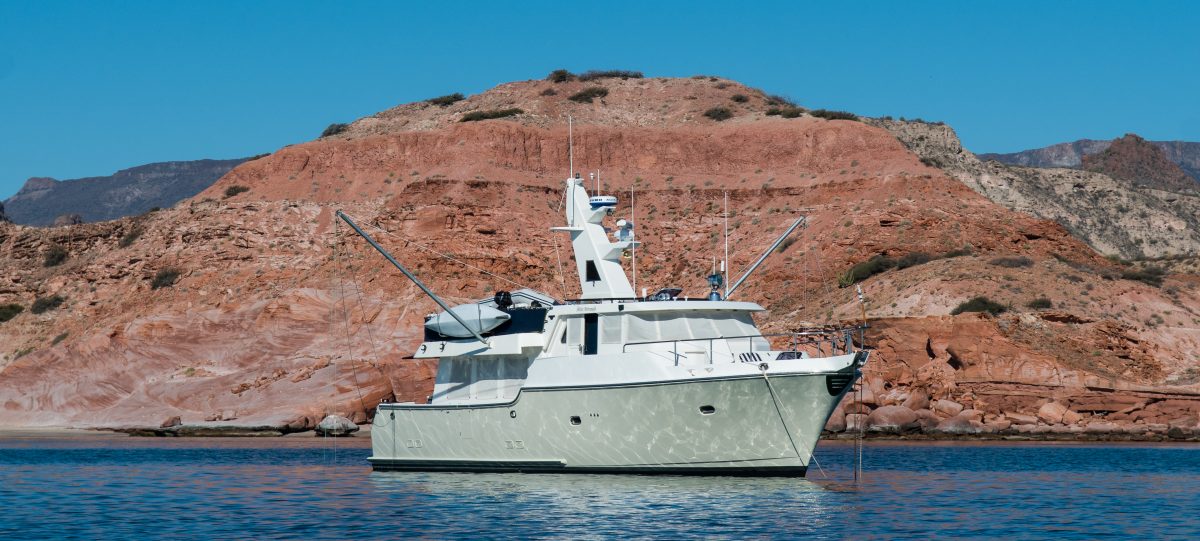
I spent some quality time in the engine room while we were at Puerto Escondido trying to diagnose the problem with air bubbles forming in the Racor filters.
I have been suspicious that there was a leak in the Racor filter manifold itself, despite it being brand new. Fellow N50 owner Ron Goldberg suggested that I test this by creating a vacuum in the filter housing and seeing if it holds. The method for creating the vacuum is to run the engine at idle and then shut off the fuel valve at the supply manifold. The engine continues trying to suck fuel in and will create a vacuum, shown on a gauge mounted on the filter manifold. When the vacuum level reaches the desired point, shut down the engine and monitor the vacuum level for a period of time. This sounds scary, but in practice was pretty easy – the vacuum rose pretty slowly after I shut off the fuel supply, and I could shut down the engine by closing the fuel solenoid. The fuel manifold lost very little vacuum over an hour, even after operating the filter selector valve a bunch of times. I concluded that there is no leak in the filter manifold.
I did the same test on the fuel supply manifold and had the same result. It too was able to maintain a vacuum, which means that none of the valves or their connection to the manifold itself were leaking. That leaves the lines back to the fuel tanks (including the fittings) or the “dip tubes” in the tanks themselves.
The next experiment was to select different tanks (Miss Miranda has 4 fuel tanks, port and starboard, forward and aft) as the supply to the filter manifold and look for changes in the amount of bubbling. To get an idea of what the bubbling looks like, take a look at this very shaky video. You can see towards the end of the video that there are few, if any bubbles. That is the result we are looking for. The bottom line was that I saw many fewer bubbles when drawing fuel from the aft tanks. These are much smaller tanks (115 vs 500+ gallons) and have shorter dip tubes, and seem to have less opportunity for air leaks. This is very good news. It seems that we should be able to run from the aft tanks with much less air leakage and much less concern about pockets forming in the Racor filter housing. Oh, and in case you were wondering, we have a fuel transfer system so that we can refill the aft tanks from the forward tanks.
The very last check was on the fittings to the forward fuel tanks. I have pretty easy access to the top of the port forward tank via a hatch in the galley floor. I disconnected the fuel supply line from that tank and inspected the adapter fitting. That fitting needs to have thread sealant on it to prevent leaks. The sealant on the fitting was 20 years old and most of it seemed to be gone. I cleaned up the fitting and applied new sealant. The tests for bubbling, unfortunately, were inconclusive. It seemed to be less than before, but still more than the aft tanks. It is possible that the source of the leak is the dip tube itself or the hose, or the fittings at either end.
I was a little bit disappointed after doing some more testing while underway. Under more load, there are still bubbles in the filter housings when drawing from the aft tanks, and after a short, two hour run, the fuel level in the filter housing was down, though less than previously. Racor does say that it is normal to have the fuel level down about halfway when you open the filter housing, so not sure if this indicates a problem. I did try drawing from the port tank while underway, and there seemed to be less bubbling than when drawing from the aft tanks, so maybe the thread sealant helped. I’ll continue running from the port tank and monitoring as we continue along the way.
I now have a very good idea of where the air leakage is coming from. I will probably wind up having to replace the supply lines and fittings to the tanks (and maybe even the dip tubes) before returning to the US, but can I can get that work done when we return to La Paz.
 MV Miss Miranda