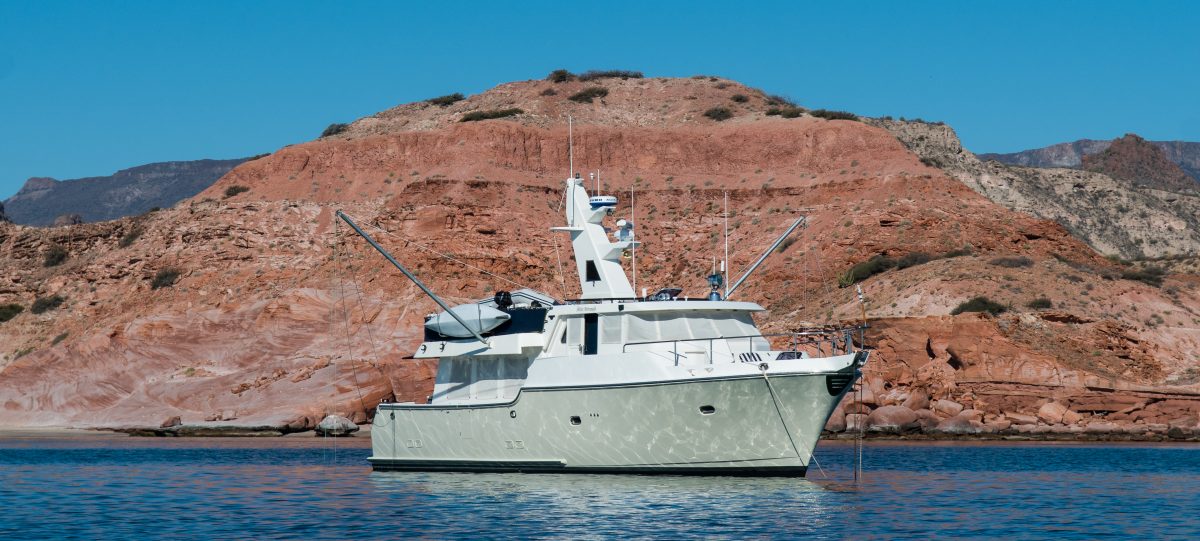
We’ve now spent a week getting to know the features and quirks of our CruiseAmerica Standard RV – the good, the bad and the ugly, so to speak. Miranda has christened this the “Bayliner of RVs”, to use a boating analogy. Now, before any Bayliner owners get their noses all out of joint, we have owned not one, but two, Bayliners, and enjoyed them both. So… we know of what we speak.
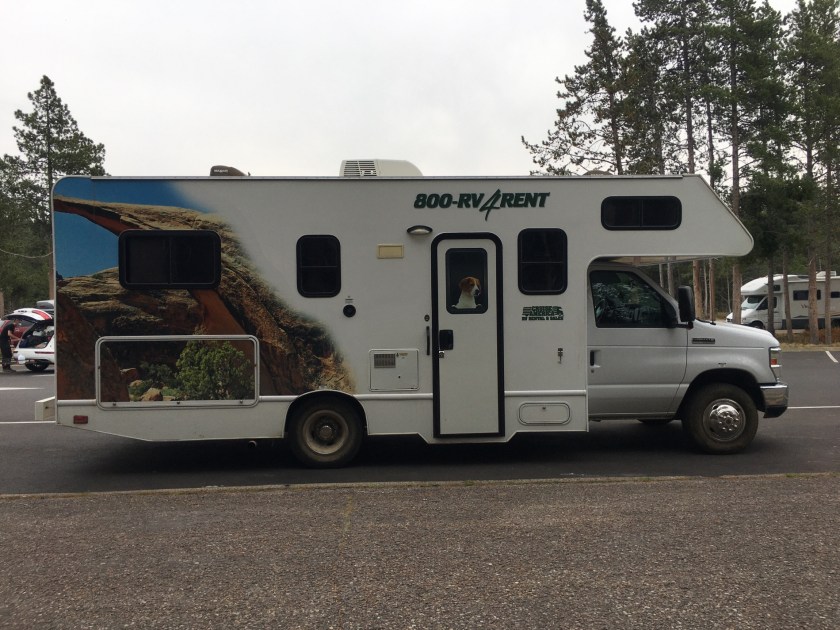
Bayliners are known to have good interior layout and good use of space. Our RV does, too. Sleeping accommodations are above the cab for Miranda and aft of the galley for me. Both can be curtained off. There is a dinette table that could accommodate 4 in a squeeze. It folds out to another berth. The galley has a deep sink, cooktop, microwave and a good sized refrigerator freezer. It is a little challenged for counter space, but has good storage space for food and utensils. There are storage cabinets up high all around, more than we need. The head is tight but functional.
Bayliners were also known for having issues with fit and finish, using some lower quality materials. Our RV suffers from the same issue. All of the lamination and edge moldings is pretty chinzy, and many have separated. Little things like locks and latches are of low quality and are bothersome. The systems work pretty well – propane for cooking, water heating, cabin heating and refrigeration, shore power for 120V AC, and a dinky DC “coach” battery. There is a basic monitoring system, but it is a bit cheesy. When we told the guy at check out that the holding tank monitor showed full, he said “yeah, that always happens”. We learned the hard way that the coach battery takes some abuse. Ours gave up in Yellowstone NP, making it so that the cabin heat would not fire up during the 30-some degree mornings. However, this is more likely a reflection on quality of service rather than equipment.
Now, as I’ve mentioned before, I suspect that our RV is heading for a refit and sale, so we might not be seeing a typical example, but ours has not worn particularly well. I had a peek at CruiseAmerica’s used RV sales pages and see that refurbished models of similar mileage go for mid-$30s… that seems like a pretty good value, assuming that everything gets fixed in the refurb process.
Miranda came up with the Bayliner moniker as we were driving down a secondary, two-lane highway that had a bit of a crown on the road surface. The RV wallowed and rolled much like our Bayliner in choppy seas. On the other hand, we flogged it over a 4900 ft mountain pass on dirt forest roads and survived. So maybe it can handle tougher conditions than we can. I’ll also note that it can’t really be driven safely faster than 65 MPH. By the time it gets to 70, it starts a little shimmy that is, shall we say, unsettling. Now you might think that 65 is plenty fast. Maybe. Unless the speed limit is 80 and you are in the right lane getting waked by everything that moves, including ALL the other RVs of various types.
So if our CruiseAmerica is the Bayliner of RVs, what is the “Nordhavn” of RVs? Forget the Super and Mega Land yachts we saw – 50 footers towing land dinghys like jeeps, SUVs and pickups. What about the roadworthy, well-built, well-finished models in the same size range? It seemed clear that the spiffy ones were built on a Mercedes Sprinter chassis and diesel powerplant.
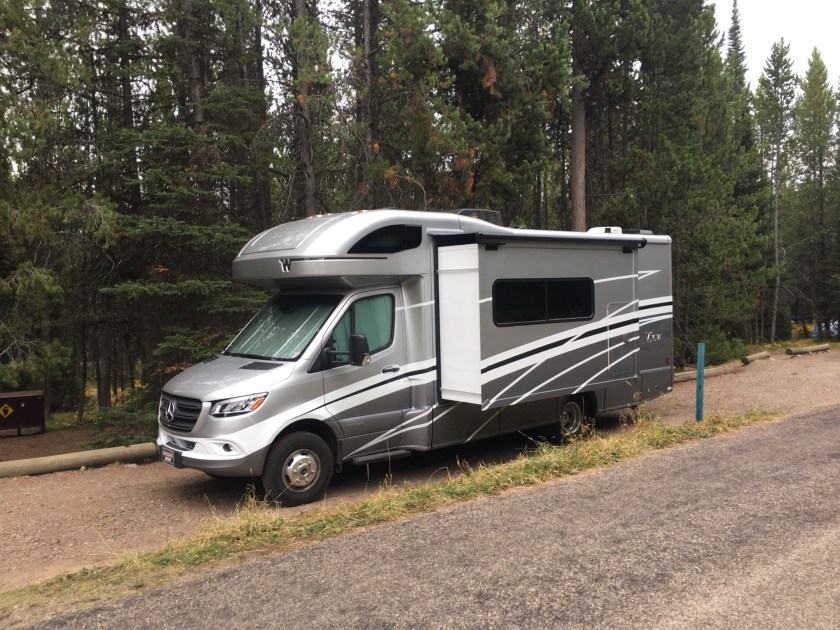
It’s clear that many companies make these – we saw them with brand names such as Jayco, Leisure, Prism and even Winnebago (a name I remember from road trips as a kid). They all seemed to be quite similar in exterior design with much more aerodynamic shapes, and in general, just looked like they were higher quality. I wonder if there is a single coach builder and all of these companies are just resellers? I didn’t get to tour the inside of any of these, but several we saw in the same size (25 ft) had side pop-outs to create more interior space. Of course, I’m sure that the price of one of these compared to our CruiseAmerica approaches the Nordhavn-Bayliner price ratio. Checking the Winnebago website shows the model above sells new for around $175k.
Miranda and I also had discussions about the “ideal” type of RV. There are several different classes of RV (which I know almost nothing about). Ours is apparently a Class C, which I think means a box built on a truck chassis. It seems to us that this is the least useful type – for example, at 25 ft long and 12 ft high, these cannot travel on the smaller roads in the national parks, including the famed Going to the Sun road in Glacier NP. A very common alternative we saw was the trailer towed by a pickup, where you can at least park the trailer and explore with the pickup. We saw these in lengths that must have been up to 40 ft, some with 3 pop-out sections. There were lots of very cool-looking variations on the Mercedes Sprinter vans, which seem to be small enough to fit on the various park roads. They do look a bit too compact for comfortable living, at least for an old guy like me. Of course, there are the Mega and Super land yachts towing the land dinghies. These all seem to be in the 40 ft range, and while I am sure they are comfortable, they seem like a handful to deal with. I concluded that the ideal setup would be to have a crewed Super land yacht that towed a 4×4 while we drove from place to place in a really nice sports car, maybe like the C8 Corvette we saw in Yellowstone.

CruiseAmerica Assistance Services
We called the CruiseAmerica Assistance Services from Old Faithful village to get the dead battery replaced. They took our information to pass onto someone who would “work the case”. About an hour later I called back, as we were waiting to explore the area. They said that they haven’t gotten to us yet. I mentioned that we were in an area with very limited phone service and couldn’t wait hours for a call back, and I asked them what their service level agreement was for returning roadside service calls. After a few moments of silence, the response was “we don’t have one, we just answers the calls in order”. I finally got a call back from someone who told me to go to any NAPA store and buy a battery, and they would reimburse me when I returned the RV. I explained that I wasn’t in a place to be able to search for NAPA stores and asked them to recommend one nearby, suggesting West Yellowstone, and specifically questioned whether the NAPA stores would actually be able to replace the battery. They sent me the info, but when I called the store, sure enough, they indicated that they don’t install batteries. Exasperated, I started searching within the park to see if there were places that might do RV repairs. It turns out that Miranda found one 100 yds away from us in Old Faithful Village. The gas station was able to replace the battery, and they were, as it turns out, a NAPA dealer. There was nothing in the documentation showing where the coach battery was located. We eventually found it and the nice guy at the service station replaced it, while also cleaning up the battery box and lubing the sliding mechanism, obviously for the first time. The battery that came out was a high quality Lifeline AGM deep cycle battery, but at a Group 31 size, clearly too small for the job. I’m sure it doesn’t help that it gets run completely down to 10V every day that it’s used. Of course, as is typical with customer service folks these days, everyone I talked to was nice… they just didn’t solve my problem.
Anyway, renter beware with regard to CruiseAmerica “assistance”.
 MV Miss Miranda